Press release —
Fuel purchase volumes drop 33% as motorists buy smaller amounts more often
Johannesburg, 2 November – Fuel purchases among Discovery Insure clients fell 33% in volume in October after the fuel price increase pushed inland 95 unleaded petrol above R30 per litre for the first time. However, while motorists have changed how they buy fuel, opting for smaller quantities more often, their everyday driving has remained the same.
An analysis of fuel transactions and telematics data from more than 200,000 Discovery Insure clients also revealed:
Smaller fuel purchases are becoming more common. The average amount purchased per transaction has fallen from about 36 litres to 31 litres during months with larger fuel price increases.
Purchases of less than 20 litres are increasing, accounting for around 36% of transactions in 2026, up from 25% in 2025.
Smaller transactions spike around payday. Between the 25th and the end of the month, these purchases account for nearly 40% of transactions during periods of significant fuel price movements, compared with 20% normally.
Everyday driving has remained largely stable, with only temporary declines in trips and kilometres travelled.
Monthly fuel expenditure has risen sharply from an average of R1,750 at the beginning of 2025 to between R2,500 and R2,700 by mid-2026.
“Motorists are clearly feeling the pressure of rising fuel prices and are becoming more deliberate about filling up,” says Robert Attwell, CEO of Discovery Insure. “We are seeing more people buy smaller amounts of fuel, especially around price changes, as they look for ways to manage their spend.”
Motorists are buying less fuel per visit to the station
The change in purchasing habits is particularly noticeable around fuel price changes. During months with large increases, purchases of less than 20 litres account for nearly 40% of transactions between the 25th and the end of the month, compared to around 20% normally.
Motorists are also visiting fuel stations more frequently ahead of the price increases, with average monthly visits rising from 2.4 to just over three.
Interestingly, the increase in smaller purchases happens whether fuel prices are going up or down, which suggests that motorists are adjusting how they fill up in anticipation of price increases, rather than always rushing to fill up before an increase.
However, some motorists still end up panic buying before the higher prices take effect. In October, fuel purchasing volumes surged by 300% before midnight on Tuesday, 6 October. Diesel purchases were up 400%. This was similar to the May increase, where purchases also surged by 300% and diesel by 450% and much higher than 200% seen during a typical price hike.
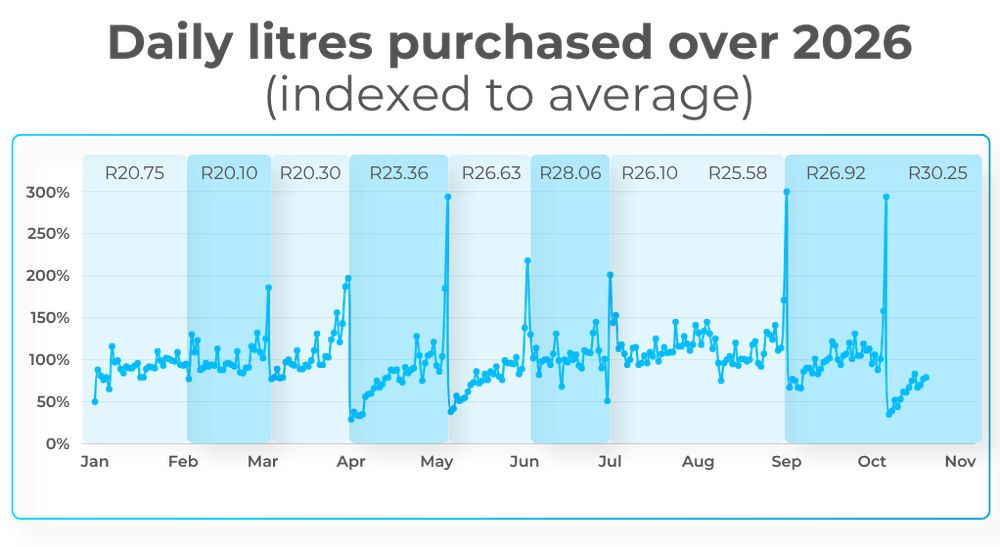
Fuel purchases fall, but driving tells a different story
While motorists are changing how they buy fuel, everyday driving remains unchanged.
In April, trips fell by 10% and kilometres travelled by 9%. Even after excluding the Easter weekend, trips and distances travelled were still down 8%. By May, motorists were travelling 9% less than before the increases.
However, these reductions proved difficult to sustain as driving returned to normal levels shortly afterwards. From June to September 2026, trips and kilometres travelled were slightly higher than the same period in 2025.
Following the October fuel price increase, trips fell again by 6%, while kilometres travelled declined by 7%.
What motorists have cut back on is discretionary travel. Discovery Insure recorded a 30% decline in long-distance trips during the winter months, while everyday commuting remained relatively the same.
These findings also align with those from SpendTrend26,a joint report by Discovery Bank and Visa, which identified fuel as an essential expense linked to daily routines, such as commuting to work, school runs, and errands.
“There’s a difference between buying less fuel and needing less fuel,” says Attwell. “Motorists can cut back on some discretionary trips, but getting to school and going about their daily lives isn’t optional. For many households, transport isn’t an expense they can simply cut.”
The ripple effect of rising fuel prices
According to Statistics South Africa (StatsSA), transport costs rose by 10.8% year-on-year, more than double the overall inflation rate of 4.5%.
Fuel prices have added to this pressure. For example, inland 95 unleaded petrol rose from R20,75 per litre in January 2026 to R30,25 per litre in October 2026 – a 46% increase. For a motorist filling a 50-litre tank, that’s an additional R475 per full tank compared to January.
This is also reflected in Discovery Insure’s data. Average monthly fuel expenditure among clients rose from approximately R1,750 at the beginning of 2025 to between R2,500 and R2,700 by mid-2026 – an increase of between 43% and 54% in over a year.
For households, the financial pressure doesn’t end at the fuel station. It follows them home, leaving less money for other essential expenses, such as food and electricity, says Sfiso Skenjana, economist and managing director at ESG Analytics.
Lower and middle-income households are particularly exposed, spending between 15% and 22% of their income on transport.
“Fuel prices don’t just affect what it costs to drive. Diesel is used to move goods and run businesses, so when diesel prices rise, the cost of everyday essentials rises too,” says Skenjana.
He describes this as the “swing effect” of fuel prices on inflation, where higher transport and operating costs can push up the prices of other goods and services. This is reflected in StatsSA’s latest Producer Price Index, which shows that prices charged by producers rose by 6.2% in September, up from 5% in August, partly driven by higher fuel costs.
“It’s difficult to even suggest pinching the wallet in an already distressed household context. We’ve already got very low savings levels in the country because people don’t actually have money.”
Motorists turn to rewards to offset rising fuel costs
With limited scope to reduce essential travel, the data suggests motorists are increasingly looking for other ways to offset fuel costs.
This is reflected in a 7% increase in the use of Discovery Insure’s Vitality Drive fuel cashback benefit, which gives qualifying Discovery Insure clients with a Discovery Bank account up to 65% back on fuel spend or R1,950 per month.
Since the launch of Vitality Drive, Discovery Insure has paid out more than R2,66 billion in rewards for driving safely.
“While motorists can’t control the price of fuel, they can take steps to manage what they can control,” concludes Attwell. “Driving more efficiently and making better use of fuel rewards can help reduce the cost of getting from A to B.”
///ENDS
NOTE TO EDITORS
- Fuel purchasing volumes are measured in litres, not in rands spent, to reflect differences among the types and grades of fuel available in South Africa
- The October analysis compares fuel purchases before and after the fuel price increase on 7 October 2026.
- Changes in trips and kilometres travelled are measured using Discovery Insure telematics data.
About Vitality Drive fuel cash back rewards
- Vitality Drive is Discovery Insure’s unique behaviour-centred driver programme that uses the latest vehicle telematics technology to record information about driving behaviour, such as acceleration, braking, cornering, speeding, night-time driving, distance driven, and cellphone use to reward clients who drive safely. In the case of a claim, telematics data is only used to verify date and time of the accident.
- As of 1 November 2026, qualifying Discovery Insure clients with a Discovery Bank account can earn up to 65% back on fuel spend, subject to programme rules.
- The maximum combined fuel reward is R1,950 per month. The maximum rewards are not guaranteed
- Fuel rewards apply to qualifying purchases at participating bp and Shell service stations.
- The percentage that clients receive depends on their qualifying Discovery Insure and Discovery Bank products, Vitality Drive status, ongoing driving behaviours and applicable programme requirements.
Topics
Categories
Discovery Insure, a division of Discovery Limited, was established in 2011 to offer flexible, innovative and comprehensive car, home and travel insurance built on the Group’s Shared‑value model. As a disruptor in South Africa’s short‑term insurance market, Discovery Insure introduced telematics‑based vehicle insurance to the South African market and continues to lead through its behaviour‑change incentive programme, Vitality Drive. This award‑winning programme rewards clients for driving well and helps reduce accidents, injuries and fatalities, thereby enhancing the safety of clients and broader society.